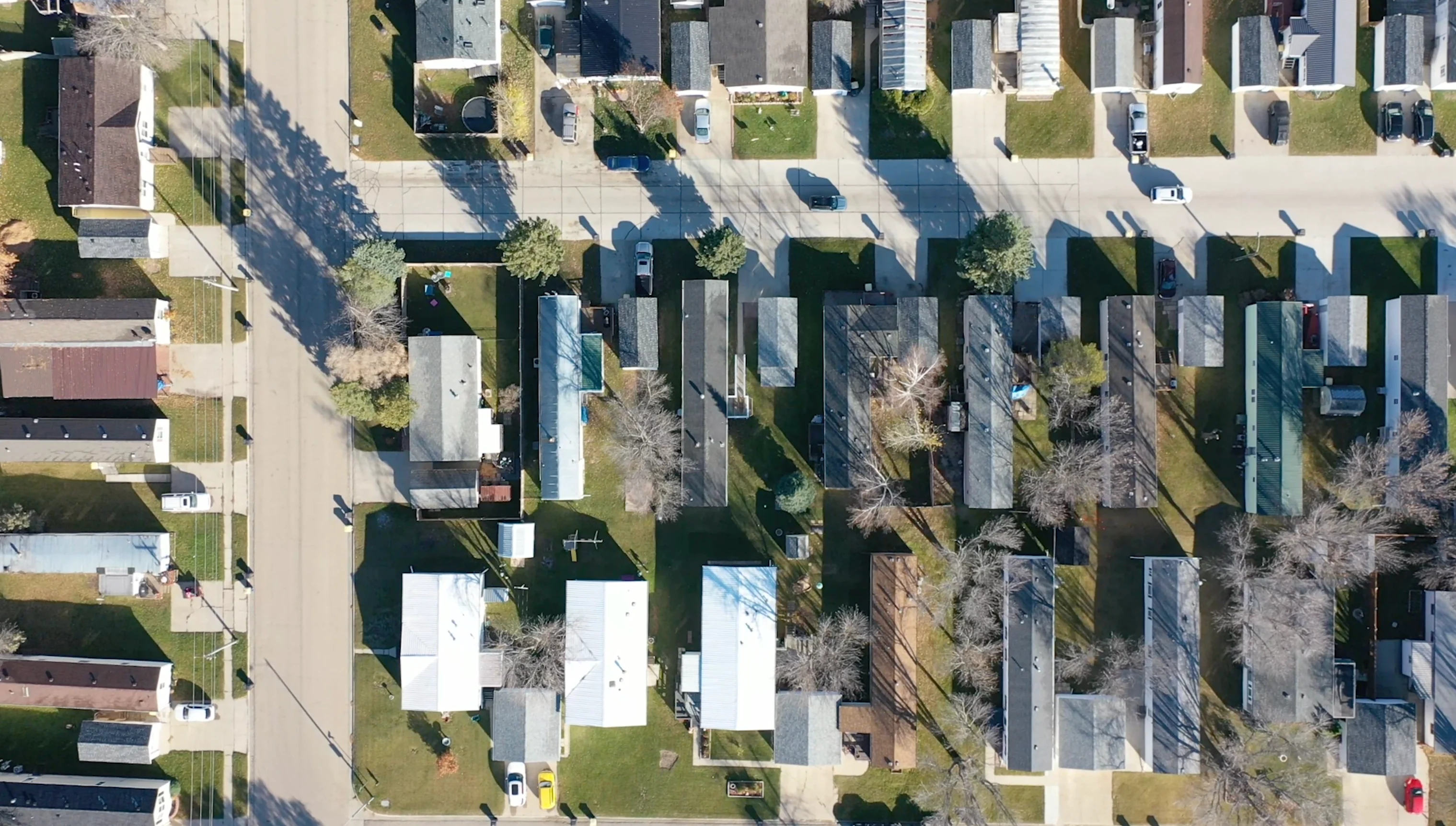
Wall Street Just Validated What We've Known All Along: What Apollo's $850M Fund Signals for Manufactured Housing
Category
Latest Updates
Date
August 10, 2026
When Apollo Global Management holds a first close on an $850 million open-ended vehicle built specifically to acquire manufactured housing parks, it's worth pausing to note what that moment represents. This isn't a niche allocator dipping a toe into an overlooked corner of real estate. It's one of the largest alternative asset managers in the world, committing nearly a billion dollars of institutional capital to a strategy designed to capitalize on prefab-friendly policy tailwinds. For those of us who have spent our careers building and operating manufactured housing communities (MHCs), this is a watershed moment, and it's one worth unpacking.
The Apollo Signal
According to reporting from PERE, Apollo has held a first close for an open-ended fund targeting manufactured housing parks, structured to take advantage of recent policy shifts favoring prefabricated and manufactured construction. The vehicle's open-ended structure is itself telling: rather than a traditional closed-end, finite-life fund built around a defined hold-and-sell timeline, Apollo is building permanent capital designed to compound in the space indefinitely. That's a structural bet on the durability of MHC cash flows, not a short-term arbitrage play.
Apollo isn't arriving new to the space. The firm has been active in manufactured housing since acquiring Inspire Communities, a 13,000-site operator, in 2017. But an $850 million dedicated, open-ended vehicle represents a meaningful step-change in scale and conviction, and it places Apollo alongside a widening circle of institutional names: Blackstone, Brookfield, Carlyle, GIC, and Invesco among them, that have all made significant manufactured housing acquisitions over the past several years.
Why the Big Players Are Circling Now
Three forces are converging to pull large-scale institutional capital into an asset class it largely ignored for decades:
1. A structural affordability crisis with no near-term resolution. As of early 2026, only about 38% of U.S. households can afford to purchase a median-priced home, down sharply from 57% just five years earlier. Manufactured housing remains one of the only forms of ownership housing that stays within reach of working- and middle-class households, which is precisely why demand for it keeps climbing even as broader housing affordability deteriorates.
2. Supply that simply cannot keep pace. Zoning restrictions, community opposition, and the sheer difficulty of siting new MHC development mean that the number of manufactured housing communities in the U.S. has been effectively flat for decades. New supply is a rounding error against existing stock. That scarcity is the single biggest driver of the sector's pricing power. Landlords aren't competing with a wave of new competitive product because there essentially isn't one.
3. Occupancy and cash-flow durability that rival, and often beat, traditional multifamily. National MHC occupancy climbed from roughly 86.5% a decade ago to nearly 94–95% today, with premium coastal and Sun Belt markets pushing toward 97–99%. Because MHC residents typically own their homes and merely lease the underlying land, turnover is dramatically lower than apartment rentals, moving a manufactured home is expensive and logistically difficult, which anchors residents in place for years, sometimes decades. That translates into remarkably stable, recession-resistant revenue streams, precisely the kind of "bond-like" cash flow institutional allocators are hunting for in a higher-rate environment.
The Fundamentals Behind the Fund Flows
For those newer to the space, it's worth stating plainly why MHCs have earned their reputation as one of the most defensive, income-durable segments of commercial real estate:
Low capital intensity relative to yield. Because residents own their own homes, owners are responsible primarily for land, infrastructure, and common-area amenities not for the depreciating physical structure itself. This creates a lower capex burden than most other residential real estate categories.
High barriers to entry. New MHC development is exceedingly rare due to zoning and NIMBY resistance, meaning existing communities benefit from what is functionally a closed universe of competitive supply.
Resilient rent growth. Even through downturns, MHC rent growth has remained positive, supported by the "sticky" nature of the resident base and the essential, affordability-driven nature of the demand.
Fragmentation creates opportunity. The vast majority of the roughly 43,000 manufactured housing communities in the U.S. remain owned by small, often unsophisticated private operators. That fragmentation gives well-capitalized, vertically integrated operators room to consolidate, professionalize management, and drive meaningful operational upside which is a dynamic that's increasingly attracting the same institutional playbook that transformed self-storage and single-family rental over the last cycle.
What This Means for Firms Like Ours
Apollo's raise in addition to Blackstone's, Brookfield's, and now GIC's and Invesco's growing presence in space is a clear signal that manufactured housing has graduated from a "mom-and-pop," overlooked niche into a mainstream institutional allocation. That's a double-edged sword for vertically integrated operators like Crystal View Capital. On one hand, rising institutional demand validates the thesis we've built our platform around and should support valuations and exit liquidity over time. On the other, it means more competition for quality assets, likely tighter cap rates on stabilized, institutional-grade communities, and a widening gap between well-capitalized consolidators and smaller operators who lack the scale to compete for deal flow.
The opportunity, as we see it, lies precisely in that gap. Large allocators like Apollo are built to write big checks into stabilized, already-professionalized portfolios, they are not typically in the business of sourcing off-market, value-add communities from independent owners, repositioning them operationally, and building scale from the ground up. That's exactly the lane vertically integrated, sourcing-driven platforms are built for. As institutional capital continues to flow toward the top of the market, the ability to originate proprietary deal flow and drive operational value creation becomes an even more durable competitive advantage, not a less relevant one.
The asset class isn't just resilient. It's becoming core. And firms that have been building expertise in this space for years are better positioned than most to benefit from the wave of capital now arriving behind them.
Sources: PERE ("Apollo raises $850m to acquire manufactured housing parks," July 28, 2026); Matthews Real Estate Investment Services; NorthMarq; Multi-Housing News; Capright; Walker & Dunlop.
001
/
Next
Explore Our Other Articles
Read expert-written articles, helpful guides, and practical resources covering the topics that matter most.